

To provide and deliver the highest quality goods, services, and corrosion solutions.

To be acknowledged as the world's leading provider of cathodic protection on subterranean pipelines and at the shoreline for corrosion control activities.

Our success rate almost 100% - ensures goal of business .

Our goal is to provide innovative, dependable, and cost-effective solutions while adhering to all applicable international standards in the cathodic protection industry while maintaining a safe working environment.
CORROSION
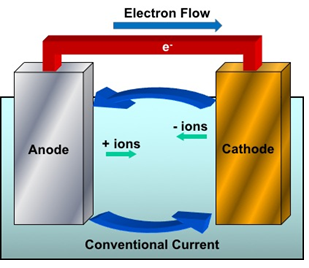
Corrosion is an electrochemical process involving the flow of electrons and ions. Metal loss (corrosion) occurs at the anode. No metal loss occurs at the cathode (the cathode is protected). Electrochemical corrosion involves the transfer of ions across metal/electrolyte interfaces.
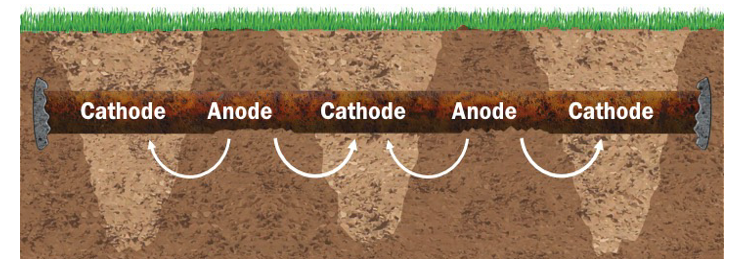
Corrosion occurs within a corrosion cell that consists of four parts:
- Anode
- Cathode
- Electrolyte
- Electronic/Metallic Path
The electrons generated by the formation of metallic ions at the anode pass through the electronic path to the surface of the cathodic areas immersed in the electrolyte. They restore the electrical balance of the system by reacting with positive ions in the electrolyte
BASIC TYPE OF CORROSION
- Galvanic Corrosion
This corrosion occurs when two dissimilar metals are connected. The potential of the two metals creates a voltage difference, the driving force for corrosion
- Crevice Corrosion
This type of corrosion occurs where two tightly spaced surfaces – either two metals or a metal and non-metal – are exposed to a corroding environment. Holes, gasket surfaces, lap joints, surface deposits, and crevices are likely places for this type of corrosion.
- Uniform Corrosion
This is a uniform type of corrosion with an even loss of metal over the entire area or a large area of the structure.
- Pitting Corrosion
Localized corrosion that occurs over a small area of the metal surface and leaves holes in the surface. Pits can be isolated or closely spaced. Pits can be small or large in diameter
- Stress Corrosion Cracking (SCC)
The cracking of a metal under an applied tensile stress in the presence of a corrosive environment.
- Microbiologically Influenced Corrosion (MIC)
Certain bacteria that exist under anaerobic conditions (absence of oxygen) can reduce sulphates and consume hydrogen in the process. Consumption of hydrogen at the structure surface depolarizes the steel at cathodic areas and permits more rapid consumption of the metal by galvanic corrosion cells
- Environmental Cracking
Environmental cracking results from the reaction of the metal with a corrosive environment and the presence of a stress.
- Intergranular Attack
This is a local corrosion attack at the grain boundaries of an alloy. It is caused by a difference in element composition near the boundaries, compared to the rest of the alloy.
- Selective Leaching
This type of corrosion involves the selective removal of one of the elements from an alloy. Examples of this type of corrosion are dezincification of brass and graphitic corrosion of cast iron.
- Velocity Phenomena
This corrosion is associated with rapid movement of a corrosive fluid over a metal, removing corrosion products. It is recognized by the appearance of grooves, trenches, etc., in the direction of fluid flow
CATHODIC PROTECTION
Cathodic protection (CP) is a corrosion-control technology that involves making a metal surface the cathode of an electrochemical cell. Shifting the corrosion rate reduces the rate of corrosion.
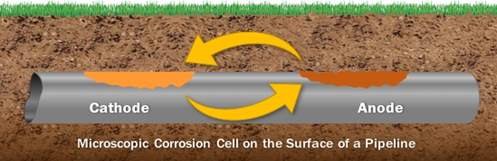
Corrosion is the result of an electrochemical reaction driven by a potential difference between two electrodes, an anode and a cathode, connected by an electronic path and immersed in the same. In the case of uniform corrosion, a multitude of microscopic anodic and cathodic sites exist on the surface of the metal structure.
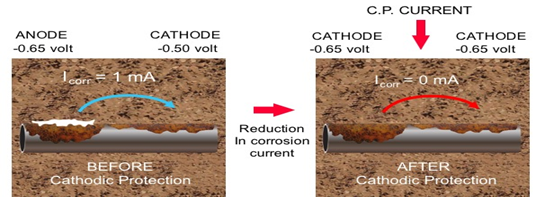
TYPES OF CATHODIC PROTECTION
- Galvanic/Sacrificial Anode Cathodic Protection
- Impressed Current Cathodic Protection
Galvanic/Sacrificial Anode Cathodic Protection
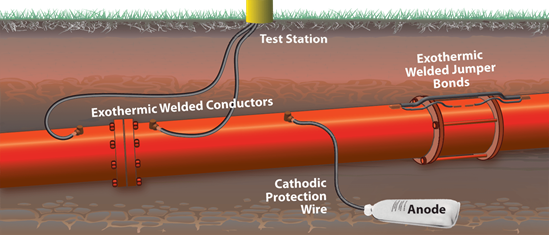
Most sacrificial (galvanic) anode systems can be routinely inspected by taking reference potential measurements at critical locations throughout the system. Since these systems usually provide low current outputs, a problem such as a shorted isolation will have a major impact on the potentials. Reference potentials are essentially a structure-to-electrolyte potential although for this purpose a large unprotected structure can be used as a reference and the data converted to a standard reference electrode. Galvanic anodes can be placed in either a distributed or remote fashion. Galvanic anodes are usually buried at relatively shallow depths at or below the ground water level, e.g., at or below pipe depth. Magnesium and zinc are available as continuous ribbon to allow use as one continuous distributed anode.
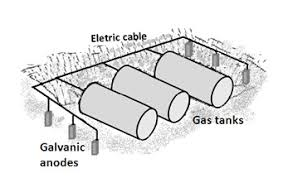
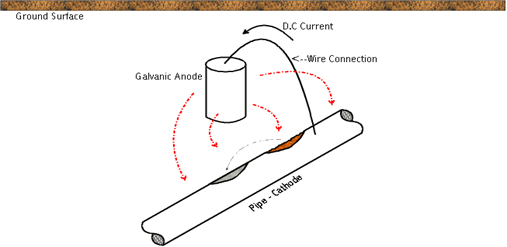
Galvanic/sacrificial anode cathodic protection systems cannot cheaply produce enough current to provide environmental corrosion protection for larger structures or when current requirements are high.
Impressed Current Cathodic Protection
Impressed current cathodic protection (ICCP) systems are employed in these instances. Anodes are connected to a DC power source, which is usually a transformer rectifier unit driven by an AC supply. Alternative power sources, such as solar panels, generators, battery etc. can be used in the absence of an AC supply.
A combination of inspections of the DC power source and potential measurements are often employed for impressed current systems. In the case of a transmission pipeline where few external problems are expected, then an inspection of the DC power sources may be sufficient.
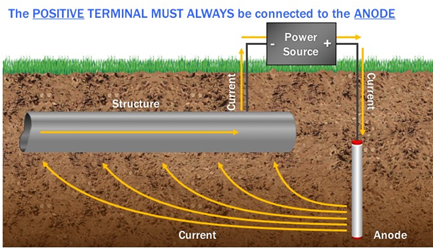
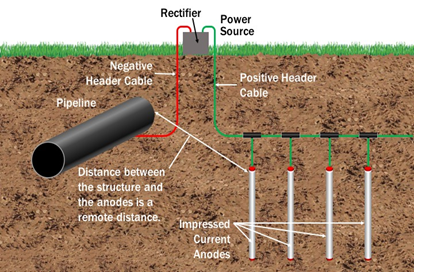
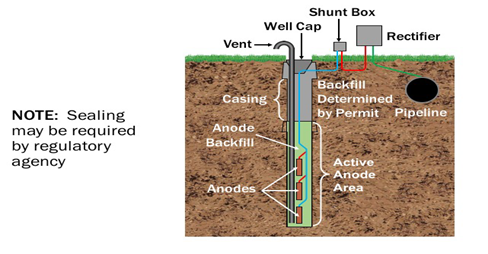
Impressed current anodes are installed either as distributed or remote anodes. Anodes can be installed in surface ground beds. In addition, impressed current anodes are used in the remote configuration by installing them in a deep hole drilled from the surface.
APPLICATIONS OF IMPRESSED CURRENT CATHODIC PROTECTION
Typical uses of impressed current are:
- for large current requirements, particularly for bare or poorly coated structures
- in all electrolyte resistivities
- as an economical way of protecting structures having dissipated galvanic anodes
- to overcome stray current or cathodic interference problems
- for protection of large heat exchanger water boxes, oil heater-treaters, and other vessels
- for interiors of water storage tanks
- for exterior bottoms (both primary and secondary) of aboveground storage tanks
- for underground storage tanks
- for foundation piles and sheet piling, both underground and in the water